
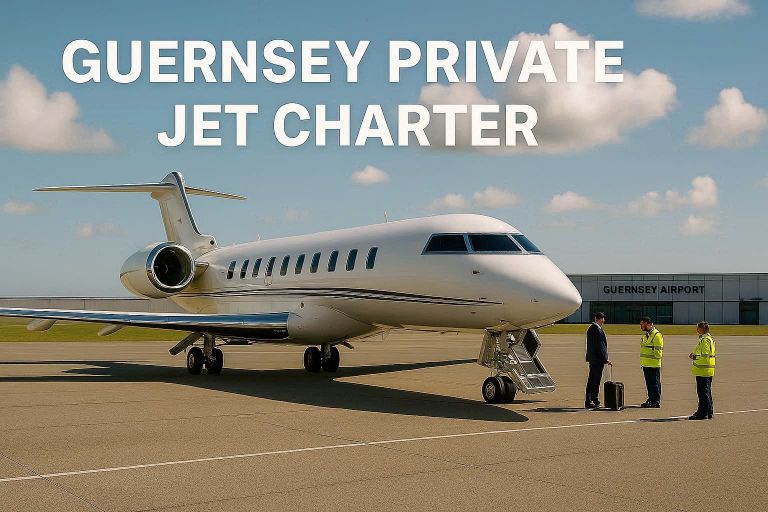
Guernsey Private Jet Charter: On-Demand Rates & Airport FBO Guide
Our Guernsey private jet charter directory connects corporate flight departments and high-net-worth individuals with on-demand luxury flight brokers operating out of Guernsey Airport.
Instead of locking capital into multi-million pound fractional jet memberships, modern executive travel across the Channel Islands utilizes flexible, pay-as-you-go private charters. This model ensures rapid deployment, strict regulatory compliance, and direct access to global aviation networks without long-term commitments.
Estimated On-Demand Private Charter Costs from Guernsey (EGJB)
The following structural matrix outlines estimated hourly rates and passenger capacities for private flights departing directly from Guernsey Airport to key European financial and luxury travel hubs:
| Aircraft Class | Average Capacity | Key Destinations (Direct From GSY) | Estimated Hourly Rate |
| Light Jet (e.g., Citation Mustang) | 4–6 Passengers | London (Farnborough), Paris, Dublin | £2,500 – £3,500 |
| Midsize Jet (e.g., Citation XLS+) | 7–9 Passengers | Geneva, Zurich, Nice (Monaco) | £4,000 – £5,500 |
| Turboprop / Super Light (e.g., King Air 350i) | 6–9 Passengers | UK Regional Airports, Isle of Man | £1,800 – £2,600 |
Guernsey Aviation: Private vs. Commercial
| Feature | Private Jet Charter | Commercial Scheduled |
|---|---|---|
| Departure | On-demand, flexible timing | Fixed airline schedules |
| Security/Customs | Dedicated FBO handling | Main terminal queues |
| Route Reach | Direct to any suitable airfield | Hub-to-hub connections only |
Operational Safety & Standards
All private charters coordinated via this directory adhere to the highest international aviation standards. Aircraft sourcing is performed in compliance with ARGUS Platinum and Wyvern Wingman safety certifications. Flights departing from Guernsey Airport (EGJB) are subject to rigorous safety checks, and all charter operators must hold valid Air Operator Certificates (AOC).
Guernsey Airport (EGJB) Corporate Dispatch Intelligence
Executive Summary: While Guernsey Airport (EGJB) handles light corporate aircraft with high efficiency, operating super-midsize or heavy-cabin aircraft reveals acute operational friction points. Dispatchers must actively manage severe runway performance penalties, tight curfews, and distinct customs frameworks that do not apply to UK mainland hubs like London Farnborough (EGLF).
The 5 Critical Operational Complications
1. Short-Runway Performance Penalties
Guernsey’s single runway measures 1,583 metres (5,194 feet). While perfectly workable for light cabin jets like the Embraer Phenom 300 or Cessna Citation XLS, it introduces severe restrictions for heavy-class aircraft (Challenger, Falcon, Global, or Gulfstream), especially during wet or windy conditions.
• Outbound Sector Restrictions: Heavy jets cannot depart at Maximum Takeoff Weight (MTOW), forcing mandatory fuel stops on long-range routes to Dubai or the US.
• The “Drop-and-Go” Reality: Due to tight landing distance calculations during winter contamination or tailwind scenarios, heavy jets frequently treat Guernsey as a drop-and-go airfield rather than a true operating base.
2. Compressed Crew Duty Windows
The standard operating window at EGJB is strictly 06:30 to 21:00 local time, with terminal hours closing at 21:00.
• No Operational Elasticity: If a corporate meeting overruns in London, Zurich, or Luxembourg, crews face immediate Flight Duty Period (FDP) complications.
• Displacement Risk: Late inbound passengers frequently force crews to unexpectedly reposition the aircraft overnight to Jersey or the UK mainland, triggering costly crew displacement fees.
3. Customs and GAR Processing Constraints
Because the Channel Islands sit outside parts of the UK customs and VAT frameworks, private aviation movements require meticulous General Aviation Report (GAR) handling and border coordination.
• Compliance Exposure: Last-minute passenger manifest amendments or rapid itinerary changes create compliance friction that would be entirely routine at Farnborough.
• Complex Rotations: A corporate itinerary moving an executive between Schengen zones, the UK, and Guernsey generates a surprisingly heavy paperwork trail.
4. Apron Capacity and Heavy Stand Allocation
While turnaround logistics for light jets are straightforward, Guernsey’s physical apron capacity and handling flexibility are finite.
• Tactical Parking Restrictions: Wingtip clearance boundaries and repositioning constraints mean that overnight parking slots for large-cabin aircraft are exceptionally rare.
• The Reposition Circuit: Dispatchers are routinely forced to execute a three-leg routing strategy: Passenger drop at Guernsey ➔ Reposition to Jersey (EGJJ), Bournemouth (EGHH), or Farnborough (EGLF) for parking ➔ Return to Guernsey later for pickup. This dramatically inflates fuel burn, handling fees, and crew duty consumption.
5. Maritime Weather Resilience
Guernsey’s maritime microclimate introduces high operational volatility compared to inland UK airfields. Fog, sudden low cloud base drops, and fierce Atlantic crosswinds degrade schedule certainty.
• Stricter Alternate Fuel Requirements: Due to the shorter runway margins, heavy jets must carry substantial contingency fuel to support dual alternates (often forcing a choice between Southampton or Jersey).
• Risk to Board Meetings: A finance director requiring absolute arrival certainty for an island board meeting face a demonstrably higher diversion probability during active weather systems.
Flight Dispatch Feasibility: EGJB
Frequently Asked Questions Regarding Channel Island Private Flights
Q: What is the fastest way to arrange a private flight out of Guernsey?
A: On-demand private jet charters can be coordinated through local Fixed-Base Operators (FBO) at Guernsey Airport, bypassing commercial security lines with terminal departures ready in less than 45 minutes from arrival.
Q: Do on-demand charters require a monthly membership or jet card?
A: No. Modern private aviation on the island operates on a pay-as-you-go, on-demand charter broker network, allowing corporate clients to pay strictly for the hours flown without upfront capital commitments.
Q: How does the runway length at Guernsey Airport (EGJB) affect my flight?
A: Guernsey’s single runway (09/27) is 1,583 metres. While it comfortably accommodates business jets like the Cessna Citation XLS or Embraer Phenom 300, larger heavy jets may face weight restrictions on long-haul routes, potentially requiring a short positioning flight to London Farnborough.
Q: What are the most common private jet routes from Guernsey?
A: Frequent routes include London (Farnborough/Luton) for finance and business connectivity, Geneva for wealth management, and seasonal routes to Nice or Cannes. Inter-island executive travel to Jersey and Alderney is also standard.
Q: How quickly can a private jet be arranged in Guernsey?
A: Through local coordination with FBOs like Aiglle Flight Support, light or midsize jets can typically be positioned and ready for departure within 2 to 4 hours, subject to customs and airfield slot availability.
Local Ground Handling & Hangar Notice: While global flight brokers regularly handle digital booking requests, securing direct hangar space, local luxury concierge ground transport, and private VIP lounge access requires direct coordination with the ground-based Fixed-Base Operator stationed physically at Guernsey Airport.